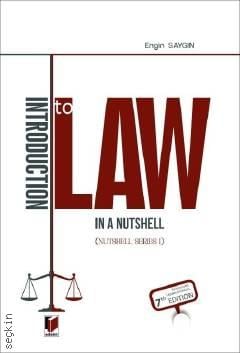
Introduction to Law in a Nutshell
7. Baskı,
Eylül 2026
Kitabın Detayları
Dili:
İngilizce
Ebat:
16x24
Sayfa Sayısı:
389
Kitabın Fiyatı:
780,00₺
İndirimli (%7):
725,40₺
Temin süresi 2-3 gündür.
Kitabın Açıklaması
Lecturers who have used the sixth edition of this book will discover much that is familiar, along with numerous changes.
• The text has been refined (e.g. in relation to tables) and updated (e.g. in relation to the amount of administrative fines in environmental law) to reflect latest information.
• References to important new research have been included to enable students and course lecturers to follow the most recent developments in the field.
Kitabın Konu Başlıkları

Social Order Rules
Systems of Law
Application of Legal Rules
Branches of Law
Constitutional Law
Administrative Law
Tax Law
International Law
Criminal Law
Civil Law
Commercial Law
Private International Law
Procedural Law
Branches of Law Where Public and Private Lawv
Kitapla İlgili Kategoriler
Kitabın İçindekileri
TABLE OF CONTENTS
TABLE OF CONTENTS
5
LIST OF TABLES
14
PREFACE TO THE SEVENTH EDITION
15
PREFACE TO THE SIXTH EDITION
16
PREFACE TO THE FIFTH EDITION
17
PREFACE TO THE FOURTH EDITION
18
PREFACE TO THE THIRD EDITION
19
PREFACE TO THE SECOND EDITION
20
FOREWORD TO THE FIRST EDITION
21
ABOUT THE AUTHOR
23
ABOUT THE BOOK
25
A NOTE FOR THE FACULTY OF LAW AND POLITICAL SCIENCES STUDENTS
27
HOW TO USE THIS BOOK
29
CHAPTER 1: SOCIAL ORDER RULES
INTRODUCTION
35
1. SOCIAL ORDER RULES
36
1.1. Religious Rules
38
1.2. Customary Rules
40
1.3. Moral Rules
42
1.4. Legal Rules
42
1.5. Comparison of Social Order Rules
43
1.6. The Relationship among Social Order Rules
45
1.6.1. The Relationship between Law and Religious Rules
46
1.6.2. The Relationship between Law and Moral Rules
47
1.6.3. The Relationship between Law and Customary Rules
50
2. DEFINITION OF LAW
50
2.1. Main Objectives of Law
52
2.2. Main Types of Legal Sanctions
53
2.3. Characteristics of Legal Rules
53
6 Table Of Contents
3. SOURCES OF LAW
54
3.1. Constitution
56
3.2. Codes (Acts, Laws, Bills and Statutes)
56
3.3. International Treaties
56
3.4. Presidential Decrees
57
3.5. By–Laws
58
3.6. Other Delegated Legislation (Subordinate Legislation)
59
3.7. Doctrine
59
3.8. Court Decisions
60
3.9. Hierarchy of Law
60
SELF–TEST QUESTIONS
62
FILL IN THE BLANKS QUESTIONS
64
TRUE/FALSE QUESTIONS
64
IN–TEXT QUESTIONS
65
SELECTED BIBLIOGRAPHY/FURTHER READING
65
CHAPTER 2: SYSTEMS OF LAW
INTRODUCTION
71
1. LEGAL SYSTEMS
73
1.1. Common Law System
75
1.2. Civil Law System
77
1.2.1. Comparison between Common Law and Civil Law
81
1.3. Religious Law System
82
2. SEVERAL CONCEPTS
83
2.1. Law & Justice
84
2.2. Legal Positivism & Natural Law
84
2.3. Domestic Law & International Law
85
2.3.1. Dualism
86
2.3.2. Monism
87
2.4. Substantive Law & Procedural Law
88
SELF–TEST QUESTIONS
89
FILL IN THE BLANKS QUESTIONS
91
TRUE/FALSE QUESTIONS
91
IN–TEXT QUESTIONS
92
SELECTED BIBLIOGRAPHY/FURTHER READING
92
Table Of Contents 7
CHAPTER 3: APPLICATION OF LEGAL RULES
INTRODUCTION
97
1. APPLICATION OF LEGAL RULES
98
1.1. Ascertaining the Applicable Rules
98
1.2. Determining Facts
99
1.3. Applying the Relevant Provisions of Rule
100
1.3.1. Syllogism
100
1.3.2. Argumentum a Contrario
101
1.3.3. Analogy (Argumentum a pari)
101
2. BURDEN OF PROOF AND PRESUMPTIONS
102
2.1. Burden of Proof
102
2.1.1. Burden of Proof in Criminal Cases
103
2.1.2. Burden of Proof in Civil Cases
103
2.2. Presumptions
104
2.2.1. Statutory Presumption
105
2.2.2. Rebuttable Presumption
105
2.2.3. Irrebuttable Presumption
107
3. INTERPRETATION OF LEGAL RULES
107
3.1. Textual Interpretation
108
3.2. Historical Interpretation
109
3.3. Logical Interpretation
110
3.4. Teleological Interpretation
110
3.5. Unrestricted Interpretation
111
SELF–TEST QUESTIONS
112
FILL IN THE BLANKS QUESTIONS
114
TRUE/FALSE QUESTIONS
114
IN–TEXT QUESTIONS
115
SELECTED BIBLIOGRAPHY/FURTHER READING
115
CHAPTER 4: BRANCHES OF LAW
INTRODUCTION
119
1. CORPUS IURIS CIVILIS
120
2. CRITERIA FOR THE DIVISION OF PUBLIC–PRIVATE LAW
124
2.1. Benefit Criterion
124
2.2. Free Will Criterion
125
8 Table Of Contents
2.3. Sovereignty Criterion
125
2.4. Equality Criterion
126
127
SELF–TEST QUESTIONS
128
FILL IN THE BLANKS QUESTIONS
130
TRUE/FALSE QUESTIONS
130
IN–TEXT QUESTIONS
131
SELECTED BIBLIOGRAPHY/FURTHER READING
131
CHAPTER 5: CONSTITUTIONAL LAW
INTRODUCTION
135
1. DEFINITION OF CONSTITUTION
135
1.1. Contents of the Constitution
137
1.1.1. Preliminary Chapter (or Preamble)
137
1.1.2. General Principles Chapter
139
1.1.3. Institutions of the State Chapter
139
1.1.4. Fundamental Rights and Freedoms Chapter
142
1.1.5. Effectiveness and Amendment Chapter
143
1.2. EssentialsRequisites of a Good Constitution
145
2. CLASSIFICATION OF CONSTITUTIONS
146
2.1. Unwritten and Written Constitutions
147
2.1.1. Merits and Demerits of Unwritten Constitutions
148
2.1.2. Merits and Demerits of Written Constitutions
150
2.2. Soft and Rigid Constitution
151
2.2.1. Merits and Demerits of Soft Constitutions
151
2.2.2. Merits and Demerits of Rigid Constitutions
152
2.3. Frame and Regular Constitution
153
3. CONSTITUTIONALISM IN THE WORLD AND TÜRKİYE
154
3.1. The History of Constitutionalism in the World
155
3.2. The Constitutional History of Türkiye
159
SELF–TEST QUESTIONS
165
FILL IN THE BLANKS QUESTIONS
167
TRUE/FALSE QUESTIONS
167
IN–TEXT QUESTIONS
168
SELECTED BIBLIOGRAPHY/FURTHER READING
168
Table Of Contents 9
CHAPTER 6: ADMINISTRATIVE LAW
INTRODUCTION
173
1. THE CONCEPT OF ADMINISTRATION
174
1.1. Division of Public–Private Administration
175
1.1.1. The Way of Establishment
175
1.1.2. The Purpose of Establishment/Activity
175
1.1.3. The Determination of Activity Areas
175
1.1.4. The Exercise of Public Power
176
1.1.5. The Principle of Equality
176
1.1.6. The Principle of Legality
176
1.1.7. The Way of Termination
176
2. THE BIRTH OF ADMINISTRATIVE LAW IN FRANCE AND TÜRKİYE
176
2.1. The Birth of Administrative Law in France
177
2.2. The Birth of Administrative Law in Türkiye
178
2.3. The Features of Administrative Law
179
3. CONSTITUTIONAL PRINCIPLES OF TURKISH ADMINISTRATIVE STRUCTURE
180
3.1. Centralisation
180
3.2. Decentralisation
182
3.3. The Integrity of the Administration
183
3.3.1. Hierarchy
183
3.3.2. Administrative Tutelage
185
3.3.3. Devolution of Powers
186
SELF–TEST QUESTIONS
189
FILL IN THE BLANKS QUESTIONS
191
TRUE/FALSE QUESTIONS
191
IN–TEXT QUESTIONS
192
SELECTED BIBLIOGRAPHY/FURTHER READING
192
CHAPTER 7: TAX LAW
INTRODUCTION
197
1. DEFINITION OF TAX
199
2. TURKISH TAXATION SYSTEM
201
2.1. Tax Procedure
201
2.2. Substantive Tax Law
203
2.2.1. Personal Income Tax
203
2.2.2. Corporate Income Tax
205
10 Table Of Contents
2.2.3. Taxes on Goods and Services
205
2.2.4. Taxes on Property
209
2.2.5. Other Taxes
210
SELF–TEST QUESTIONS
212
FILL IN THE BLANKS QUESTIONS
214
TRUE/FALSE QUESTIONS
214
IN–TEXT QUESTIONS
215
SELECTED BIBLIOGRAPHY/FURTHER READING
215
CHAPTER 8: INTERNATIONAL LAW
INTRODUCTION
219
1. THE CONCEPT OF THE STATE
222
1.1. The State and Society
223
1.2. The State and Nation
225
1.3. The State and Government
226
2. THE ELEMENTS OF THE STATE
227
2.1. Territory
227
2.1.1. Background Note on Aegean Disputes Between Türkiye and Greece
229
2.2. Population
234
2.3. Sovereignty
235
2.3.1. Internal Sovereignty & External Sovereignty
238
2.3.2. Real Sovereignty & Nominal Sovereignty
238
2.3.3. Legal Sovereignty & Political Sovereignty & Popular Sovereignty
238
2.3.4. De Jure Sovereignty & De Facto Sovereignty
239
3. THE THEORIES OF THE STATE
240
3.1. Voluntaristic Theories
240
3.2. Theory of the Contract
241
3.3. Coercive Theory
242
3.4. Environmental Circumscription
243
3.5. Political Evolution
244
SELF–TEST QUESTIONS
245
FILL IN THE BLANKS QUESTIONS
247
TRUE/FALSE QUESTIONS
247
IN–TEXT QUESTIONS
248
SELECTED BIBLIOGRAPHY/FURTHER READING
248
Table Of Contents 11
CHAPTER 9: CRIMINAL LAW
INTRODUCTION
253
1. THE DEFINITION OF CRIMINAL LAW
255
2. MAJOR ASPECTS OF CRIMINAL LAW
255
2.1. Definition of Crimes
255
2.2. Types of Crimes
259
2.3. Sanctions
263
2.4. Principle of Non–Retroactivity
267
3. THE AIMS OF PUNISHMENT
267
SELF–TEST QUESTIONS
271
FILL IN THE BLANKS QUESTIONS
273
TRUE/FALSE QUESTIONS
273
IN–TEXT QUESTIONS
274
SELECTED BIBLIOGRAPHY/FURTHER READING
274
CHAPTER 10: CIVIL LAW
INTRODUCTION
279
1. TURKISH CIVIL CODE
280
1.1. Preliminary Chapter (Articles 1–7)
280
1.2. Book One (Articles 8–117): Law of Persons
283
1.2.1. Classification of Persons
283
1.2.2. Beginning and End of Personality
284
1.2.3. Capacity
285
1.3. Book Two (Articles 118–494): Family Law
288
1.3.1. Filiation
288
1.3.2. Marriage
291
1.3.3. Divorce
292
1.4. Book Three (Articles 495–682): Law of Succession
295
1.4.1. Intestate Succession
296
1.4.2. Testate Succession
297
1.4.3. Agreement of Inheritance
298
1.4.4. Limit of Free Will
298
1.4.5. Reserved Portions
298
1.4.6. Disclaim of Inheritance
299
1.5. Book Four (Articles 683–1027): Law of Property
299
2. TURKISH LAW OF OBLIGATIONS
300
2.1. Contracts
300
2.2. Illegal Acts (Torts)
300
2.3. Unjust Enrichments
301
SELF–TEST QUESTIONS
302
FILL IN THE BLANKS QUESTIONS
304
12 Table Of Contents
TRUE/FALSE QUESTIONS
304
IN–TEXT QUESTIONS
305
SELECTED BIBLIOGRAPHY/FURTHER READING
305
CHAPTER 11: COMMERCIAL LAW
INTRODUCTION
309
1. GENERAL PRINCIPLES OF COMMERCIAL LAW
309
2. TURKISH COMMERCIAL CODE
311
2.1. Preliminary Chapter (Articles 1–10)
312
2.2. Book One (Article 11–123): Commercial (Business) Enterprises
315
2.3. Book Two (Article 124–644): Business Associations (Corporate Law)
317
2.3.1. Collective Company
318
2.3.2. Commandite Company
319
2.3.3. Joint Stock Company
319
2.3.4. Limited Companies
320
2.3.5. Cooperatives
320
2.4. Book Three (Article 645–849): Commercial Papers
320
2.5. Book Four (Article 850–930): Transport Business
322
2.6. Book Five (Article 931–1400): Maritime Law
322
2.7. Book Six (Article 1401–1535): Insurance Law
323
SELF–TEST QUESTIONS
324
FILL IN THE BLANKS QUESTIONS
326
TRUE/FALSE QUESTIONS
326
IN–TEXT QUESTIONS
327
SELECTED BIBLIOGRAPHY/FURTHER READING
327
CHAPTER 12: PRIVATE INTERNATIONAL LAW
INTRODUCTION
331
1. CONFLICT OF LAWS
333
2. LAW OF NATIONALITY
335
3. LAW OF ALIENS (FOREIGNERS)
338
SELF–TEST QUESTIONS
345
FILL IN THE BLANKS QUESTIONS
347
TRUE/FALSE QUESTIONS
347
IN–TEXT QUESTIONS
348
SELECTED BIBLIOGRAPHY/FURTHER READING
348
CHAPTER 13: PROCEDURAL LAW
INTRODUCTION
351
1. THE LAW OF CIVIL PROCEDURE
352
2. THE LAW OF CRIMINAL PROCEDURE
354
Table Of Contents 13
3. THE LAW OF ADMINISTRATIVE PROCEDURE
362
SELF–TEST QUESTIONS
366
FILL IN THE BLANKS QUESTIONS
368
TRUE/FALSE QUESTIONS
368
IN–TEXT QUESTIONS
369
SELECTED BIBLIOGRAPHY/FURTHER READING
369
CHAPTER 14: BRANCHES OF LAW WHERE PUBLIC AND PRIVATE LAW
CHARACTERISTICS ARE MIXED
INTRODUCTION
373
1. LABOUR LAW
373
1.1. Individual Labour Law
375
1.1.1. Contract of Employment
376
1.1.2. Types of Employment Contracts
377
1.1.3. Termination of Labour Contracts
377
1.1.4. Obligations and Duties of Employer
381
1.1.5. Obligations and Duties of Employee
383
1.2. Collective Labour Law
383
1.3. Labour Judiciary
385
2. ENVIRONMENTAL LAW
386
3. BANKING LAW
389
SELF–TEST QUESTIONS
394
FILL IN THE BLANKS QUESTIONS
396
TRUE/FALSE QUESTIONS
396
IN–TEXT QUESTIONS
397
SELECTED BIBLIOGRAPHY/FURTHER READING
397
ALPHABETICAL INDEX OF THE POLITICAL ENTITIES AND CORRESPONDING LEGAL
SYSTEMS
399
GLOSSARY
407
INDEX
413
LIST OF TABLES
TABLE 1– CONTENT OF MECELLE
40
TABLE 2– SIMILARITIES AMONG SOCIAL ORDER RULES
43
TABLE 3– DIFFERENCES AMONG SOCIAL ORDER RULES
45
TABLE 4– MAIN LEGAL SANCTIONS
53
TABLE 5– SOURCES OF LAW
55
TABLE 6– THE MOST COMMON LATIN PHARESES IN LEGAL TEXTS
78
TABLE 7– ARISTOTLE’S CLASSIFICATION OF CONSTITUTIONS
147
TABLE 8– CONSTITUTIONS IN THE WORLD
157
TABLE 9– REALISATION AND RATES OF IMPORTANT TAX TYPES IN TÜRKIYE
197
TABLE 10– TAX LIABILITY
204
TABLE 11– LIST OF VAT RATES APPLIED IN THE MEMBER STATES OF TH EU
207
TABLE 12– DIFFERENCES BETWEEN THE STATE AND SOCIETY
224
TABLE 13– DIFFERENCES BETWEEN THE STATE AND NATION
225
TABLE 14– DIFFERENCES BETWEEN THE STATE AND GOVERNMENT
227
TABLE 15– FORMS OF INTENT
258
TABLE 16– MODES OF PARTICIPATION IN CRIMES
260
TABLE 17– LIST OF OFFENCES IN THE TURKISH PENAL CODE
261
TABLE 18– TYPES OF CAPACITY IN TURKISH LAW
288
TABLE 19– DIFFERENCES BETWEEN THE CONSEQUENCES OF CERTAIN TYPES OF
AFFINITIES
291
TABLE 20– COMPARISON OF TORTIOUS LIABILITY AND BREACH OF CONTRACTUAL
OBLIGATION
301
TABLE 21– APPROVAL OF THE COMMERCIAL BOOKS
317
TABLE 22– CIVIL COURTS OF FIRST INSTANCE
353
TABLE 23– CRIMINAL COURTS OF FIRST INSTANCE
357
TABLE 24– THE BASIC PRINCIPLES OF THE LAW OF CIVIL AND CRIMINAL PROCEDURES
361
TABLE 25– ADMINISTRATIVE FEES FOR ENVIRONMENTAL DAMAGES BETWEEN
01/01/2026 AND 31/12/2026
389
Kitabın Fiyatı:
780,00₺
İndirimli (%7):
725,40₺
Temin süresi 2-3 gündür.
Bu kitaplar da ilginizi çekebilir

Hukuka Giriş (THD)
İhsan Erdoğan

Hukuk Başlangıcı
Ender Ethem Atay

Temel Hukuk ve İletişim Hukuku Dersleri
Ergin Ergül
Hukuka Giriş ve Hukukun Temel Kavramları
A. Şeref Gözübüyük
Hakkımızda
|
Uluslararası Yayınevi Belgesi|
Kaynakça Dosyası|
Kişisel Verilerin Korunması |
Üyelik|
Siparişlerim|
İade Politikası|
İletişim